Melaythenner Teeackana Warrana (Heart of Country) Aboriginal Corporation (MTWAC) was formed in 2008, after a group of Tasmanian Aboriginal people came together to discuss how Community could be inclusive and have a voice especially in the area of Cultural Heritage and Knowledge. It currently operates as a not-for-profit organisation with operations centered on Tebrakunna Country (Cape Portland) in Trouwunna (Tasmania). MTWAC members are the direct descendants of the ancestors of Tebrakunna country, who were removed from their traditional lands in the early-to-mid-1800s.
The organisation’s current co-chairs are Mark Harriss and Professor Emma Lee OAM. Nick Cameron is the outgoing chair and incoming inaugural CEO of the organisation. Nick has worked closely with the CED Manager in the region as part of the organisation’s 5-year journey with Many Rivers.
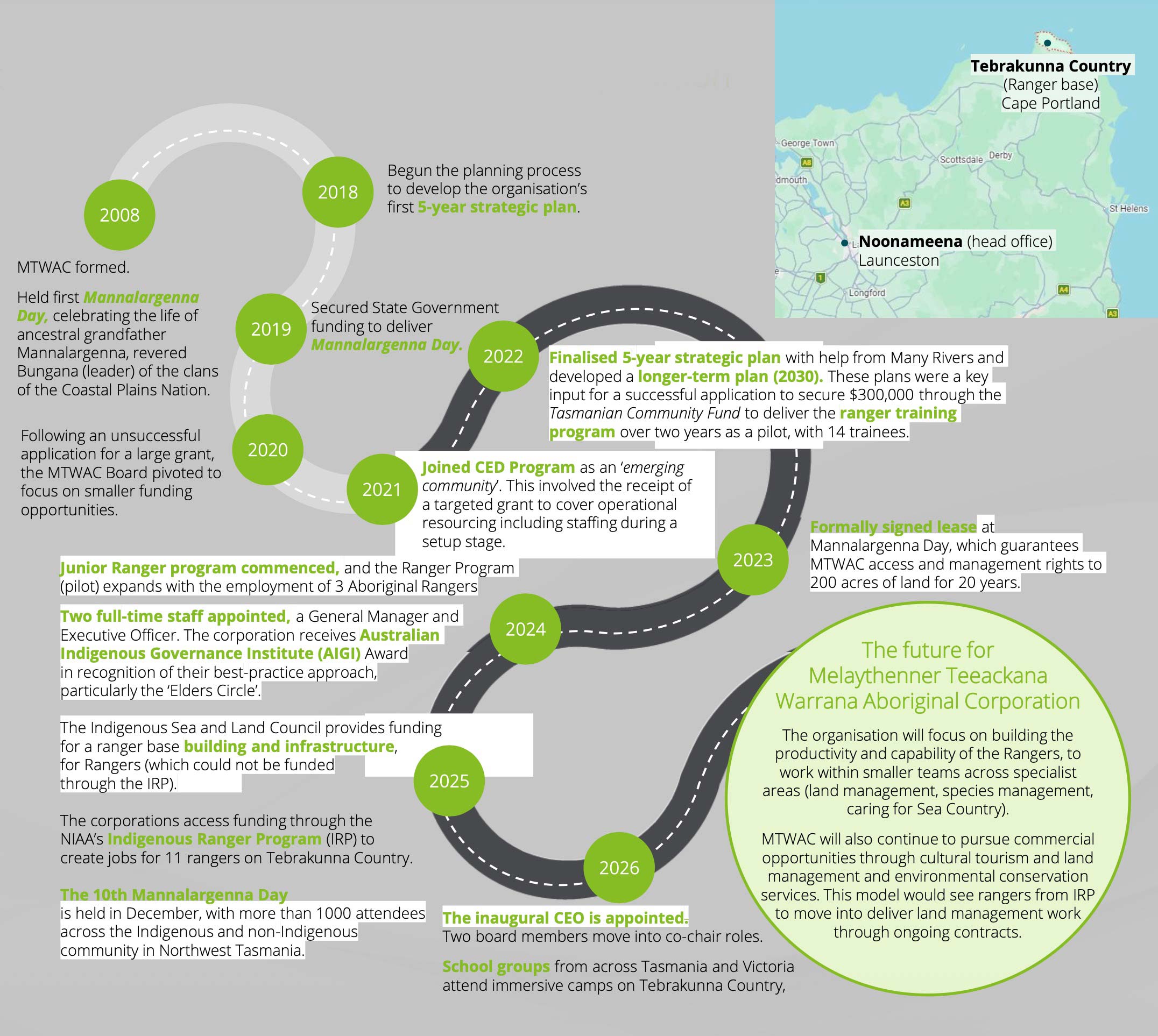
The leadership group noted that by taking small progressive steps, the organisation has grown to over 300 members and hosts an annual event with 1000 people in attendance last year. Their success is both in organisational governance – the organisation received an Australian Indigenous Governance Institute (AIGI) Award in 2024 – and in the rapid growth in the organisation’s programs and employment – particularly through the scaling of their Tebrakunna Rangers program since 2023.
Goals
Following a period of growth in the organisation’s activities, which has coincided with growth in employment (within the organisation’s administrative teams, and across its programs), the Co-chairs and CEO described their next goal as “bringing MTWAC into a stabilisation phase”, with a continued presence on Tebrakunna Country, delivering the Ranger Program effectively (with a view to seek further funding in 2028), and continuing to deliver the annual Mannalargena Day.
MTWAC is also increasingly focused on youth, through the establishment of the Youth Hub in Launceston continued delivery of the Junior Ranger program (separate to the IRP, also working on country) and the delivery of school camps.
Unpacking the ‘how’ of community economic development
Examples of the CED activity and outcomes in the Melaythenner Teeackana Warrana Aboriginal Corporation Journey
Community agendas and conversations with community highlight the CED Program’s role in supporting MTWAC to:
Translating a vision to a sequenced, strategic plan
Informed by meeting with the MTWAC Chair at the time, the CEDM drafted a proposed ’8 year plan’ (to 2030) which set out a sequenced set of tasks to build toward the goals defined by the
community. This plan was then refined through discussion with the board and has been used as a basis to prioritise activity around 5 strategy priorities (see right).
Supporting operations
The CEDM focused initial support to the organisation as it moved from volunteer, Board-run to an operational entity. This included:
- Supporting the Board to secure funding to initiate their first program (Ranger training program)
- Working alongside their first part-time paid staff (an organisational manager on a short-term contract) to identify resources, necessary policies and procedures and funding priorities.
- The scoping and recruitment of a fulltime GM role (development of the PD, recruiting and onboarding)
More recently, as the organisation has funded more administrative positions and trained staff, the CEDM has become an advisor, focuses less on day-to-day operations and supporting with new processes, such as the recent CEO recruitment.
Strengthening financial management
Across the organisation’s journey, the CEDM has worked with the Chair, GM and CEO to:
- Refine 5-year cashflow projections
- Support the development of Ranger sponsorship package and commercial costings
- Review IPA funding guidelines and prepare for IPA community consultations presentation
- Supporting funding applications for the Ranger Program (IRP)
- Preparing business plans which sit within funding /grant applications (e.g., the ILSC application).